How to Choose a Wool Scarf: Fiber, Size, Weave and Warmth

A warm scarf should make winter dressing easier, not add a bulky knot that fights with every coat you own. The right choice depends on the climate, the coat neckline, how you like to tie it and how much care you are prepared to give the fabric. Fiber matters, but it is only one part of the decision: yarn quality, weave, size and finishing can change how a scarf feels and performs.
Before comparing labels such as merino, cashmere or alpaca, think about the job the scarf needs to do. A scarf for a cold commute may need enough length to wrap and tuck into a coat. One for a mild winter may be lighter and more decorative. If you want a single everyday scarf, choose a weight and color that work with more than one outer layer.
Start with the coat and the climate
Look at the coats you wear most often. A high-neck puffer or funnel-neck coat may already protect the neck, so a bulky scarf can feel crowded. A tailored coat with open lapels leaves more room for a wrap or a long scarf. If your coat has a hood, test whether the scarf can sit underneath it without pushing the hood away from your head.
Climate changes the useful balance between warmth and bulk. Windy, exposed commutes may call for a denser weave that can be wrapped securely. In a milder city winter, a lighter scarf may be more comfortable indoors and easier to carry when you take off your coat. There is no single warmth rating for every scarf, so use the fiber label together with the fabric's thickness and construction.
Compare the fibers by feel and care, not only price
Merino wool
Merino is a fine type of sheep's wool that can feel soft against the neck. Woolmark describes wool as a fiber that manages heat and moisture, and notes that finer merino fibers can feel comfortable next to the skin. For a scarf, check the actual hand feel rather than relying only on the word merino: yarn twist, knit density and finishing all affect softness.
Lambswool and other sheep's wool
Sheep's-wool scarves vary widely in texture, thickness and finish. A more substantial knit can feel cozy and hold volume, while a smoother woven scarf may sit more neatly under a coat. If you are sensitive to scratchiness, touch the scarf against the side of your neck before buying. A label that says wool does not tell you everything about the yarn or the surface treatment.
Cashmere
Cashmere comes from the fine undercoat of the cashmere goat. The U.S. Federal Trade Commission explains that the word has a defined fiber meaning for labeling, so a product's composition should be checked rather than inferred from its price or marketing language. A cashmere scarf can feel soft and light, but its durability depends on the yarn, construction and care. A very fine scarf may need more careful handling than a denser everyday knit.
Alpaca
Alpaca is another animal fiber used in scarves and knitwear. It can feel smooth and warm, but the result varies with the fineness of the fiber, the yarn and the weave. If the scarf feels unusually slick, fuzzy or coarse, consider whether that texture suits your skin and coat. Do not assume that a higher price or a luxury-sounding label guarantees a better match for your needs.
Blends
Blended scarves combine fibers for a particular feel, price or performance. A wool blend may be easier to maintain or more affordable than a pure-fiber version, but the percentage matters. Read the full label and check whether the blend still provides the softness and warmth you want. If a scarf is mostly synthetic, it may be easier to care for, but it will not behave exactly like a wool or cashmere knit.
Choose a size you can actually wear
Length affects how many ways you can tie a scarf. A shorter scarf may be easy to loop once and tuck into a coat, while a longer scarf gives you more options for wrapping, draping or leaving the ends loose. Width changes how much fabric gathers around the neck. A wide wrap can add warmth over an open coat, but it may be too bulky under a high collar.
Try the scarf with your outerwear before removing the tags. Wrap it the way you normally would and check that the ends do not drag, the knot does not press against your throat and the fabric can sit inside the coat without bunching. If you often carry a bag, see whether the scarf catches on the strap or slips off your shoulder when you move.
Read the weave and finish
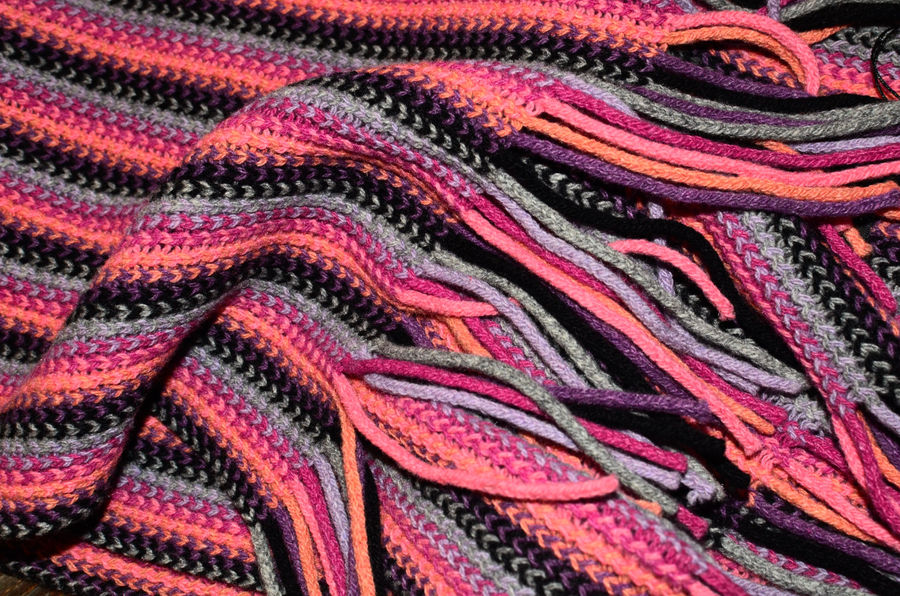
A dense woven scarf tends to create a flatter, more streamlined layer, while a chunky knit adds volume and visible texture. Brushed finishes can feel soft but may catch on rough hardware or rougher coat fabrics. Fringe adds movement, but very long fringe can tangle in zippers and bag straps. Check the edges, seams and ends for loose yarns, uneven tension or a finish that already looks stretched.
Pilling is not an automatic sign that a scarf is poor quality. Woolmark explains that pilling can result from friction during wear, especially where fabric rubs against other surfaces. A scarf that constantly meets a coat collar or bag strap may develop small pills over time. What matters is whether the fabric feels well made, whether the pilling is manageable and whether the scarf can be cared for without damaging the yarn.
Match the scarf to the coat's neckline
With a coat that has wide lapels, a long scarf can sit in the open space and become part of the outfit. With a high collar, a smaller wrap or a scarf tucked inside may be more comfortable. A scarf coat already has fabric built into the neckline, so a second bulky scarf may compete with the design. The proportions in Scarf Coat Guide are useful when deciding how much extra volume the neck area can handle.
Open lapels: a longer scarf can drape down the front or wrap once without crowding the collar.
High collar or funnel neck: choose a thinner scarf that can sit inside the coat, or skip it if the collar already feels warm.
Hooded coat: test the scarf under the hood so the fabric does not push the hood away from your head.
Care is part of the buying decision
A scarf that needs special care may still be worth buying, but be realistic about how often you will wear it. Check the care label before washing, steaming or storing it. Some wool items can be washed on a wool cycle, while others require hand washing or professional care. Lay a wet knit flat if the label calls for it; hanging a heavy, damp scarf can stretch it out of shape.
Air the scarf between wears and remove small pills gently rather than pulling at loose fibers. Before storing it for the season, make sure it is clean and completely dry. Fold or roll it rather than leaving it knotted on a hook for months. For more detailed guidance on animal-fiber garments, see How to Tell If a Cashmere Sweater Is Good Quality and How to Wash Cashmere at Home.
A short buying checklist
Choose the scarf's main job first: daily commute, outdoor warmth, travel or a lighter styling layer.
Read the full fiber composition instead of relying on a single word on the front label.
Try the width and length with the coat you will wear most often.
Check the weave, edges, fringe and surface for loose yarns or uneven finishing.
Read the care label and decide whether the routine fits your real habits.
Frequently asked questions
**Is merino or cashmere better for a scarf?** Neither is automatically better. Merino can be a practical everyday option, while cashmere may appeal when softness and low weight are priorities. The best choice depends on the scarf's construction, your skin sensitivity, climate and care routine.
**How long should a winter scarf be?** Long enough to wrap comfortably in the way you prefer, but not so long that the ends drag or catch on bags and doors. Try the scarf with your coat rather than choosing by a number alone.
**Should a wool scarf be washed after every wear?** Usually not. Air it between wears and follow the care label when it needs cleaning. Avoid assuming that every wool or cashmere scarf can be machine washed.
Further reading
For ways to wear a scarf with outerwear, see How to Wear a Scarf With a Wool Coat, Scarf Coat Guide and How to Choose Winter Gloves. For fiber properties and labeling, consult Woolmark's wool fiber guide and the FTC's cashmere labeling guidance.


Comments