How to Choose a Messenger Bag: Size, Strap Fit and Everyday Style

A messenger bag is useful because it keeps daily essentials close while leaving both hands free. But the category includes very different shapes: slim document bags, padded laptop carriers, structured leather satchels and technical courier bags. Choosing by appearance alone can leave you with a bag that is too small, too heavy or uncomfortable when it is full.
Start with the things you carry and the way you move. A bag for a laptop commute needs a different interior from a small crossbody for a phone, wallet and notebook. Strap length, body width and pocket placement affect comfort just as much as the outer material. A well-chosen messenger bag should fit your load without dominating your outfit.
Start with the load, not the laptop label
Write down the largest objects you carry on a normal day: laptop, tablet, charger, notebook, water bottle, headphones, lunch container or camera. Measure the laptop itself, including any protective sleeve. A bag described as fitting a 14-inch laptop may have a compartment that is too narrow for a bulky case, so compare the compartment's actual internal dimensions with the device.
Think about volume as well as width and height. A slim bag can fit a laptop and notebook but may not leave room for a charger brick or water bottle. A deeper bag can carry more, but it may bulge away from the body and swing as you walk. The right capacity is the smallest one that comfortably holds your usual load with a little room for an occasional extra item.
Use dimensions and capacity to choose the right size
Manufacturers sometimes publish volume in liters, laptop size and exterior dimensions. These numbers are useful when compared together. Timbuk2's Classic Messenger size guide, for example, lists an X-Small at 6 liters for an 11-inch tablet, a Small at 11 liters for a laptop up to 13 inches, and a Medium at 16 liters for a laptop up to 16 inches. Its larger sizes add more depth and capacity. These are brand-specific examples, not universal sizing rules.
Measure the bag's internal sleeve, not only its exterior. Check whether the laptop compartment is padded, suspended above the bottom or simply a divider pocket. A bag can fit a device but still offer little impact protection if the laptop sits directly against the base. If you carry electronics in wet weather, look for a secure closure and a water-resistant or waterproof liner rather than assuming that the outer fabric is enough.
Set the strap so the bag sits securely
A messenger bag can be worn on one shoulder or across the body. For walking, crossbody carry often keeps the bag more stable, but the strap should be adjusted so the bag does not hit the hip with every step. Many people prefer the bag to sit around the hip or slightly above it, where the contents remain accessible without pulling the shoulder forward.
A wider strap and a movable shoulder pad can help distribute pressure when the bag is heavy. Look for an adjuster that stays in place, smooth webbing that does not twist and a buckle you can operate without taking the bag off. Some larger commuter bags include a stabilizer strap that connects to the bag or belt area to reduce swing while cycling. It is useful for active travel but may be unnecessary for a light everyday bag.
Choose the material for weather, weight and maintenance
Leather
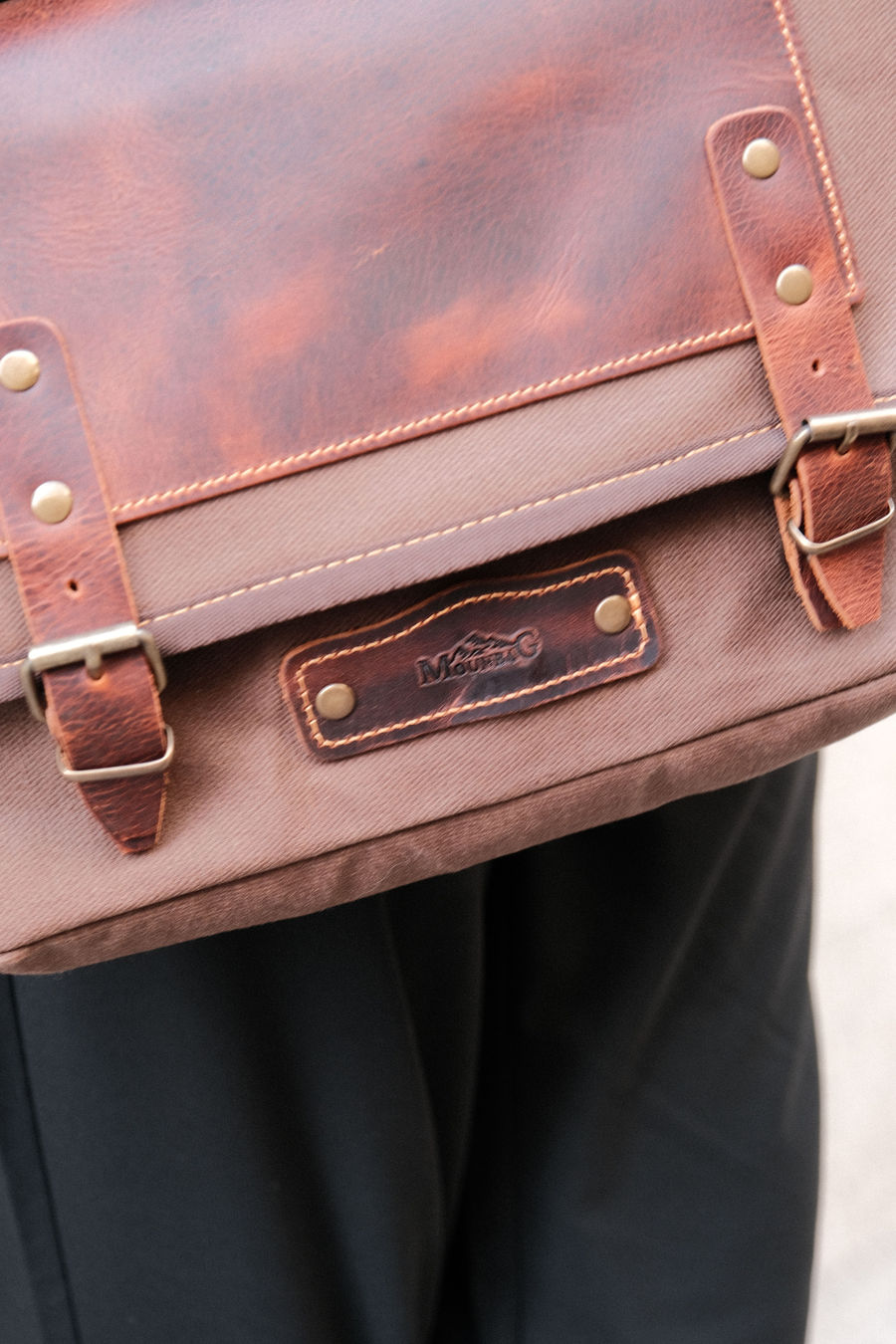
Leather messenger bags look refined and can work with tailored trousers, wool coats and smart-casual clothing. They are often heavier than fabric bags and need care to avoid drying, scratching or water marks. Check whether the leather is full-grain, corrected-grain or coated, and ask how the maker recommends cleaning and conditioning it. A structured leather bag can hold its shape, but it may be less forgiving when overfilled.
Canvas and cotton blends
Canvas has a casual, workwear feel and is often lighter than thick leather. It can soften with use and may develop a worn-in appearance. However, untreated canvas can absorb water and stains. If you want it for rainy commutes, check whether it has a water-repellent finish, coated base or separate liner.
Technical nylon and recycled polyester
Technical fabrics can be light, durable and easy to wipe down. They suit commuters who carry electronics or move between public transit, cycling and walking. Look for abrasion-resistant fabric, reliable zippers, reinforced attachment points and clear information about water resistance. A waterproof liner can protect contents even if the outer material becomes wet.
Choose a shape that matches how you use it
A flat messenger is good for documents, a tablet and a few slim essentials. A structured satchel keeps its outline and looks more formal, but may feel stiff when carried for a long time. A technical courier bag offers organization, weather protection and a strap system designed for movement. A leather flap bag is more of a style piece and may be best when the daily load is modest.
The closure also changes how the bag works. A flap with buckles looks classic but can be slower to open than a zipper. A magnetic snap is quick, though it should not be the only security feature if you carry valuable electronics. Internal dividers, key clips and quick-access pockets are helpful only when they match the items you actually use; extra compartments can make a simple bag harder to pack.
Style the bag without letting it overpower the outfit
With casual denim and utility layers
A canvas or technical messenger works naturally with straight denim, a simple knit and a utility jacket. Keep the bag close to the color of your shoes or outerwear if you want a quiet result. If the bag has bright hardware or a large logo, reduce other accessories so the outfit has one clear focal point.
With smart-casual clothing
A clean leather or matte nylon messenger can sit comfortably with tailored trousers, an overshirt and a wool coat. Choose a size that does not extend far beyond the width of your torso. A very large bag can make a polished outfit look more like a travel uniform, while a compact bag keeps the silhouette sharper.
With winter outerwear
Test the strap over the coat you wear most often. A strap that works over a T-shirt may slide over a smooth puffer or bunch the shoulder of a heavy wool coat. A padded or grippy strap can help, and a bag with a slightly wider opening is easier to use when you are wearing gloves.
For a broader city wardrobe, pair your bag with the layers in our urban clothing style guide or men's winter smart-casual outfit guide; the new urban menswear guide explains how utility pieces and tailored layers work together.
What to check before buying
Measure the laptop, sleeve and largest daily item; compare those measurements with the bag's internal dimensions.
Check the bag's volume and depth so it can hold your load without bulging or swinging.
Try the strap over the coat or jacket you will wear most often and adjust it while the bag is loaded.
Inspect stitching, strap anchors, buckles, zippers and the bottom panel, which take repeated stress.
Look for padding and a secure closure if you carry electronics, and check the maker's weather-protection claims.
Review the warranty, repair service and cleaning instructions before paying for premium leather or technical materials.
Messenger bag questions before you buy
Is a messenger bag better than a backpack?
It depends on the load and your route. A messenger bag gives quick side access and a more compact profile, while a backpack usually distributes a heavy load across both shoulders more evenly. If you carry a heavy laptop and several books for long periods, compare both styles while fully loaded.
How high should a messenger bag sit?
There is no single correct height, but it should remain stable, avoid striking your thigh and allow you to reach inside without twisting awkwardly. Adjust the strap with the actual contents in the bag, not when it is empty.
Can a leather messenger bag be used in rain?
Some treated leathers tolerate light moisture, but leather is not automatically waterproof. Use the care instructions from the maker, protect electronics with an inner sleeve and avoid leaving a soaked bag near direct heat.
Further reading and photo credits
Trend and product references: Vogue's Fall/Winter 2026 menswear predictions and GQ's Fall/Winter 2026 menswear trend report provide current context; Timbuk2's Classic Messenger size guide provides brand-specific dimensions and strap features used as examples.
Cover photograph: Alfauz, Pexels source image; in-body leather-bag detail: Yasar Baskurt, Pexels source image. Both are used under the Pexels License; source URLs and photographer labels are recorded in Wix Media Manager.



Comments